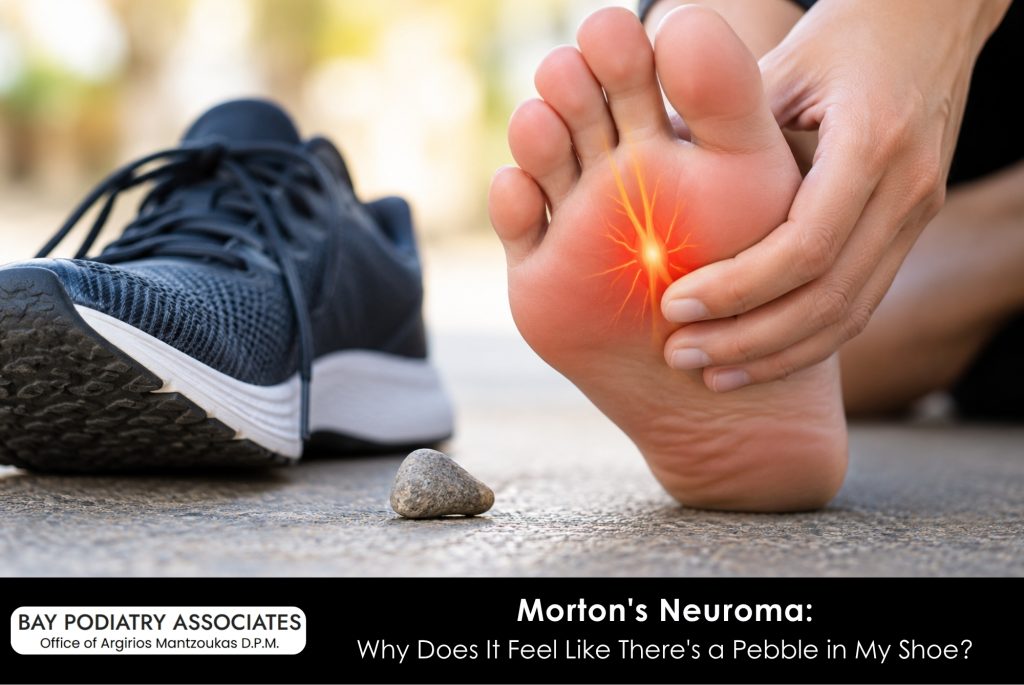
Have you ever taken off your shoe because you were convinced a pebble was trapped underneath the ball of your foot—only to discover nothing was there?
That strange sensation can be associated with Morton’s neuroma, a painful condition involving a nerve in the forefoot. Patients may also experience burning, tingling, numbness, or shooting discomfort extending into the toes.
Because several conditions can cause pain in the ball of the foot, a podiatric evaluation is important for an accurate diagnosis.
Bay Podiatry Associates in Brooklyn, NY evaluates forefoot pain, nerve symptoms, and other conditions that can make walking uncomfortable.
What Is Morton’s Neuroma?
Morton’s neuroma involves thickening and irritation of tissue around one of the nerves traveling toward the toes.
It most commonly develops between the third and fourth toes, although symptoms can occur in other areas of the forefoot.
Despite its name, a Morton’s neuroma is not typically a cancerous tumor. It represents a painful nerve-related condition caused by chronic irritation or compression.
What Does Morton’s Neuroma Feel Like?
Symptoms can include:
- Burning pain in the ball of the foot
- Tingling in the toes
- Toe numbness
- Sharp or shooting pain
- The sensation of standing on a pebble
- The feeling that a sock is folded underneath the foot
- Pain that worsens in certain shoes
Symptoms may initially occur intermittently and become more frequent over time.
Why Does It Feel Like There Is Something in My Shoe?
An irritated nerve in the forefoot can create unusual sensory signals.
The brain interprets those signals as pressure, fullness, burning, or the sensation of an object beneath the foot even when no physical object is present.
This “pebble in the shoe” description is frequently associated with Morton’s neuroma.
What Causes Morton’s Neuroma?
Anything that repeatedly compresses or irritates the nerve may contribute.
Potential factors include:
- Tight footwear
- Narrow toe boxes
- High heels
- Repetitive forefoot pressure
- Certain foot structures
- Abnormal biomechanics
- Activities that repeatedly load the forefoot
Often, several factors work together.
Why Can High Heels Make Neuroma Pain Worse?
High heels shift body weight toward the front of the foot.
This increases pressure across the metatarsal region, where the affected nerves are located.
Shoes with narrow toe boxes can simultaneously squeeze the metatarsal bones together, potentially increasing nerve compression.
Is Morton’s Neuroma the Same as Metatarsalgia?
No.
Metatarsalgia is a broad term describing pain in the ball of the foot. Morton’s neuroma is a specific nerve-related condition that can cause forefoot pain.
Someone with metatarsalgia-like symptoms may actually have a neuroma, stress injury, joint disorder, sesamoid problem, callus, or another condition.
How Is Morton’s Neuroma Diagnosed?
A podiatrist typically asks where the pain occurs, which toes are affected, what shoes aggravate symptoms, and whether numbness or tingling is present.
During the examination, pressure may be applied to different areas of the forefoot to identify the source of pain.
Imaging or other testing may sometimes be recommended to exclude other causes of forefoot symptoms.
Can Morton’s Neuroma Go Away Without Treatment?
Symptoms may temporarily improve when pressure on the nerve is reduced.
However, recurrent symptoms suggest that the underlying nerve irritation is continuing.
Early evaluation may provide more opportunities for conservative management before symptoms become persistent.
How Is Morton’s Neuroma Treated?
Treatment depends on symptom severity and contributing factors.
Conservative approaches may include:
- Footwear modification
- Reducing forefoot pressure
- Activity modification
- Padding
- Orthotics when appropriate
- Medications or injections when medically indicated
- Other podiatric treatments
Persistent cases that do not respond to conservative care may require additional intervention.
Can Custom Orthotics Help Morton’s Neuroma?
Orthotics may help selected patients when foot mechanics contribute to excessive forefoot pressure.
The goal may be to redistribute forces and reduce irritation around the affected nerve.
Not every patient with a neuroma requires custom orthotics, so recommendations should be individualized.
What Happens if Morton’s Neuroma Is Ignored?
Symptoms may become more frequent or persistent in some patients.
People may also begin changing the way they walk to avoid pain, potentially creating additional mechanical stress elsewhere in the foot or lower extremity.
Persistent numbness, burning, or forefoot pain should therefore be evaluated.
When Should You See a Podiatrist?
Consider scheduling an appointment when you repeatedly experience burning, tingling, numbness, shooting pain, or a pebble-like sensation in the ball of the foot.
Pain that affects walking, exercise, work, or shoe choices also deserves evaluation.
Frequently Asked Questions About Morton’s Neuroma
Why does it feel like there is a pebble in my shoe when nothing is there?
Morton’s neuroma is one possible explanation. Nerve irritation in the forefoot can create the sensation of pressure or an object beneath the foot.
Where does Morton’s neuroma hurt?
Pain most commonly occurs in the ball of the foot and may extend into the third and fourth toes.
Can Morton’s neuroma cause numb toes?
Yes. Numbness and tingling in adjacent toes are common symptoms.
Is Morton’s neuroma a tumor?
Despite the term “neuroma,” Morton’s neuroma generally refers to thickened tissue surrounding an irritated nerve rather than a typical cancerous tumor.
Can tight shoes cause Morton’s neuroma?
Tight or narrow footwear can increase forefoot compression and aggravate symptoms.
Are high heels bad for Morton’s neuroma?
High heels increase pressure on the forefoot and can worsen symptoms in susceptible patients.
How can I tell the difference between Morton’s neuroma and metatarsalgia?
Symptoms overlap. Morton’s neuroma specifically involves nerve irritation, while metatarsalgia broadly describes forefoot pain. A podiatric examination can help distinguish the cause.
Can Morton’s neuroma be treated without surgery?
Many patients begin with conservative treatment. Surgery or other procedures may be considered when persistent symptoms fail to respond adequately to nonsurgical care.
Can orthotics help a neuroma?
They may help selected patients by redistributing pressure and addressing contributing biomechanics.
When should I see a podiatrist for ball-of-the-foot pain?
Seek evaluation when pain repeatedly returns, worsens, causes numbness or tingling, or interferes with normal walking and activities.
Contact Information
If it feels like you are walking on a pebble—or burning, tingling, or numbness is affecting the ball of your foot—Bay Podiatry Associates can evaluate your symptoms and determine whether Morton’s neuroma or another forefoot condition may be responsible.
Bay Podiatry Associates
8635 21 St Ave Suite 1C
Brooklyn, NY 11214
Phone: (718) 266-1986
Website: baypodiatrybrooklyn.com
Book Online: baypodiatrybrooklyn.com/appointments/