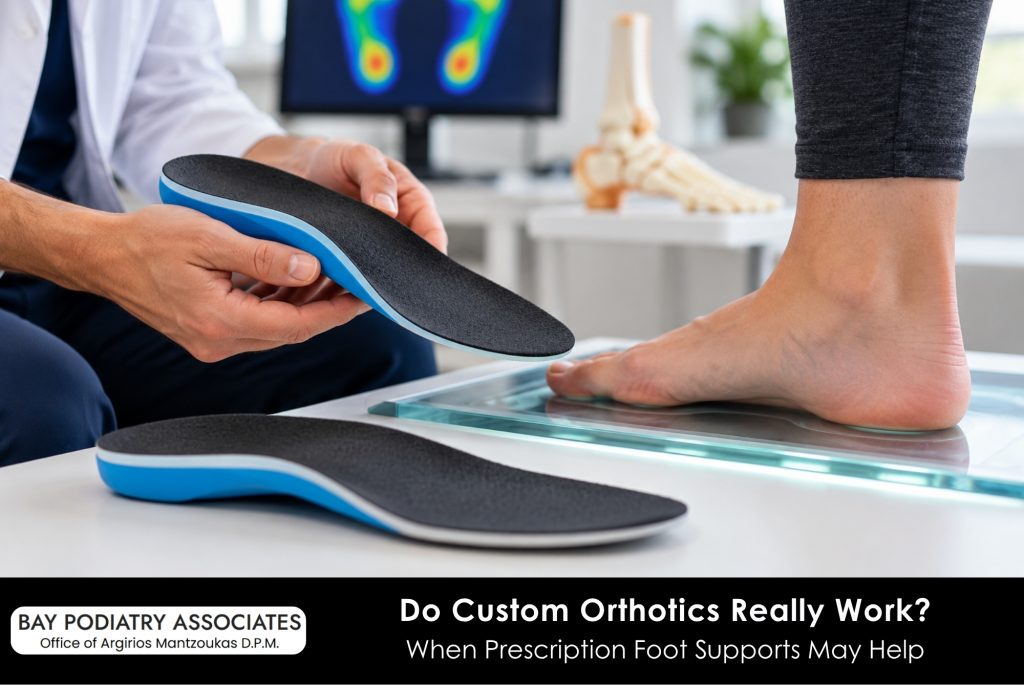
Custom orthotics are often discussed as a solution for foot pain, but patients naturally want to know whether they actually work and whether they are truly different from the inserts sold in pharmacies and shoe stores.
The answer depends on the underlying problem.
Custom orthotics are not a universal treatment for every type of foot pain. For selected patients, however, they can be useful tools for improving how pressure is distributed across the feet, supporting certain structural or biomechanical needs, and reducing stress on painful tissues.
Bay Podiatry Associates in Brooklyn, NY evaluates foot mechanics and can determine whether custom orthotics may be appropriate as part of an individualized treatment plan.
What Are Custom Orthotics?
Custom orthotics are prescription devices designed specifically for an individual patient’s feet and biomechanical needs.
They are worn inside shoes and may be used to alter pressure distribution, improve support, accommodate deformities, or influence the way the foot functions during standing and walking.
Are Custom Orthotics the Same as Store-Bought Insoles?
No.
Over-the-counter inserts are mass-produced in standard sizes and shapes. They may provide additional cushioning or general support and can be useful for some people.
Custom orthotics are made based on a clinical evaluation and individual foot measurements or impressions.
Neither option is automatically superior for every patient. The appropriate choice depends on the condition being treated.
What Conditions May Benefit From Custom Orthotics?
Orthotics may be considered for conditions involving abnormal biomechanics or pressure distribution.
These can include:
- Plantar fasciitis
- Flat feet
- Certain types of heel pain
- Metatarsalgia
- Some bunion-related symptoms
- Certain tendon disorders
- Recurrent pressure areas
- Some cases of ankle instability
- Arthritis-related discomfort
- Selected diabetic foot problems
A diagnosis should come before an orthotic prescription.
Can Orthotics Help Plantar Fasciitis?
For some patients, yes.
Plantar fasciitis can be influenced by foot mechanics and repetitive stress. An orthotic may help redistribute forces and reduce stress on the plantar fascia.
However, stretching, footwear changes, activity modification, and other treatments may also be necessary.
Can Orthotics Help Flat Feet?
They may help selected patients with symptomatic flat feet by providing support and improving pressure distribution.
Not everyone with flat feet needs treatment. Orthotics are generally considered when the foot shape contributes to pain, fatigue, instability, or other symptoms.
Do Orthotics Correct Bunions?
Orthotics do not typically reverse an established bunion deformity.
However, they may help selected patients by addressing certain mechanical stresses and improving comfort.
Patients with progressive or painful bunions should be evaluated for a comprehensive treatment plan.
Can Orthotics Help Knee or Back Pain?
Foot mechanics can influence movement farther up the body, but not every case of knee, hip, or back pain originates in the feet.
Orthotics may help certain patients when lower-extremity biomechanics contribute to symptoms.
A proper evaluation is important before assuming foot supports will solve pain elsewhere.
How Are Custom Orthotics Made?
The process typically begins with a podiatric examination.
The podiatrist may assess:
- Foot structure
- Arch shape
- Range of motion
- Gait
- Areas of pressure
- Shoe wear patterns
- Symptoms
- Activity level
Measurements, impressions, or digital methods may then be used to create a device tailored to the patient’s needs.
How Long Does It Take to Get Used to Orthotics?
Some patients need an adjustment period.
The feet and lower extremities may require time to adapt to changes in support and pressure distribution.
A gradual break-in schedule may be recommended.
Persistent pain or new symptoms should be discussed with the prescribing podiatrist.
Do Custom Orthotics Last Forever?
No.
The materials can wear down over time, and a person’s feet, activity level, body mechanics, or medical needs may change.
Orthotics may need periodic evaluation, refurbishment, or replacement depending on use and condition.
Are Custom Orthotics Worth It?
For the right patient and diagnosis, they can be a valuable part of treatment.
The key is determining whether the problem is one that can realistically benefit from mechanical support or pressure redistribution.
Orthotics should not be viewed as a one-size-fits-all solution.
Frequently Asked Questions About Custom Orthotics
What is the difference between orthotics and insoles?
Insoles are generally mass-produced cushioning or support products, while custom orthotics are prescription devices made for an individual’s feet and treatment goals.
Are custom orthotics only for flat feet?
No. They may be used for many conditions involving biomechanics or pressure distribution.
Can orthotics cure plantar fasciitis?
Orthotics may help reduce stress on the plantar fascia, but treatment often involves several approaches.
Do I need custom orthotics if store-bought inserts help?
Not necessarily. Some patients do well with over-the-counter support, while others need a more individualized device.
Can orthotics make foot pain worse?
An improperly selected or poorly fitting device can cause discomfort. New or worsening symptoms should be evaluated.
How long do custom orthotics last?
Lifespan varies based on materials, body weight, activity level, footwear, and frequency of use.
Can I move custom orthotics between shoes?
Often yes, if the shoes have enough room and a compatible structure. Some patients may need more than one pair depending on their footwear.
Do orthotics work for athletes?
They may help selected athletes who have biomechanical or pressure-related problems, but they are not necessary for every athlete.
How do I know if I need custom orthotics?
A podiatric evaluation can determine whether symptoms are likely to benefit from an individualized orthotic prescription.
Contact Information
If persistent foot pain or abnormal foot mechanics are affecting your daily activities, Bay Podiatry Associates can determine whether custom orthotics may be appropriate for you.
Bay Podiatry Associates
8635 21 St Ave Suite 1C
Brooklyn, NY 11214
Phone: (718) 266-1986
Website: baypodiatrybrooklyn.com
Book Online: baypodiatrybrooklyn.com/appointments/