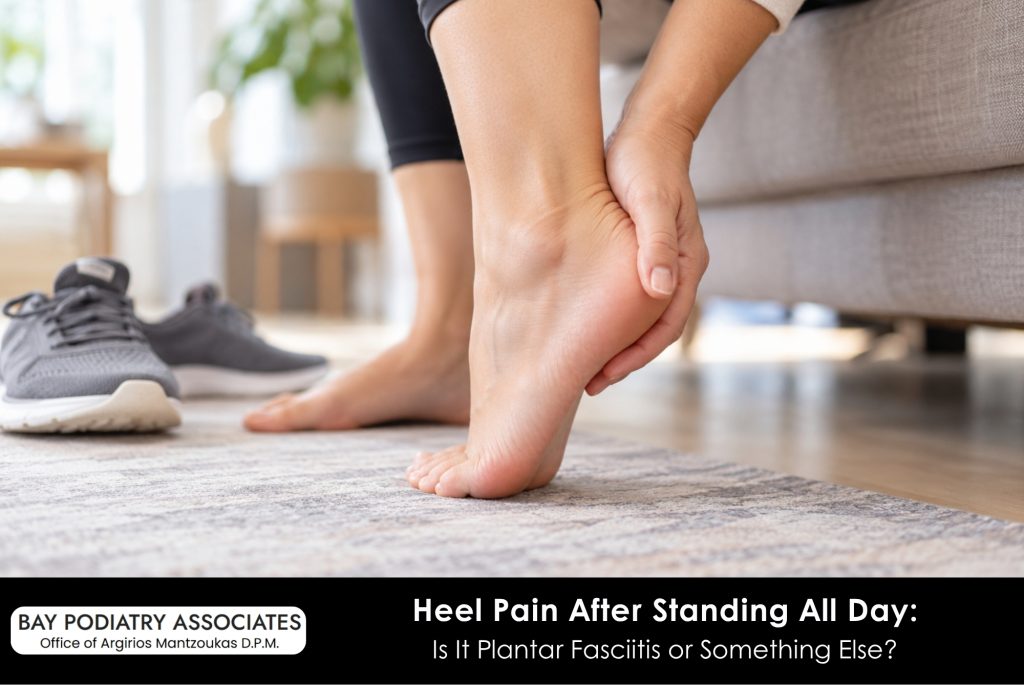
If your heels feel fine in the morning but become increasingly painful after hours of standing, you may wonder whether plantar fasciitis is responsible.
Plantar fasciitis is a common cause of heel pain, but it is not the only condition that can become more noticeable after prolonged standing. Heel pad irritation, Achilles tendon problems, stress injuries, arthritis, and abnormal foot mechanics can produce similar symptoms.
Bay Podiatry Associates in Brooklyn, NY evaluates heel pain to determine what is actually causing discomfort rather than assuming every painful heel is plantar fasciitis.
Why Does Standing All Day Make My Heels Hurt?
Standing subjects the feet to prolonged mechanical loading.
Over many hours, tissues can become fatigued or irritated, especially when combined with:
- Hard floors
- Unsupportive footwear
- Abnormal foot mechanics
- Tight calf muscles
- Increased body weight
- Limited recovery time
Is Plantar Fasciitis Worse After Standing?
It can be.
Many people with plantar fasciitis experience pain after prolonged standing or walking.
Some also notice classic first-step pain in the morning or after sitting.
What Does Plantar Fasciitis Usually Feel Like?
Typical symptoms include:
- Pain under the heel
- Pain toward the inner side of the heel
- First-step pain
- Pain after prolonged standing
- Tenderness near the plantar fascia attachment
Symptoms often fluctuate throughout the day.
Could Heel Pad Syndrome Be the Cause?
Yes.
The heel pad is a natural cushion beneath the heel bone.
Repeated impact, prolonged standing, or age-related changes can reduce its ability to absorb pressure.
Heel pad pain may feel like deep bruising in the center of the heel.
Could the Achilles Tendon Cause Heel Pain After Standing?
Yes.
Achilles tendon irritation usually causes pain at the back of the heel rather than underneath it.
Patients may also notice morning stiffness or pain during stairs and push-off.
Can Hard Floors Cause Heel Pain?
They can contribute.
Standing on concrete, tile, and other hard surfaces for long periods may increase repetitive stress.
Proper footwear and cushioning can help reduce some of that load.
Can Worn-Out Shoes Cause Heel Pain?
Yes.
Shoes gradually lose cushioning and support.
Old footwear may no longer protect the heel effectively during prolonged standing.
Can Flat Feet Contribute to Heel Pain?
Yes.
Certain flatfoot mechanics can increase strain on the plantar fascia and other structures.
Not every person with flat feet develops pain, but biomechanics may be an important factor in some cases.
How Is Heel Pain Diagnosed?
A podiatrist may evaluate:
- Pain location
- Foot structure
- Flexibility
- Gait
- Heel tenderness
- Footwear
- Activity level
- Work demands
Imaging may be recommended when another condition is suspected.
What Can Help Heel Pain From Standing?
Treatment may include:
- Supportive footwear
- Activity modification
- Stretching
- Orthotics when appropriate
- Ice
- Medication when medically suitable
- Addressing contributing biomechanics
The treatment should match the diagnosis.
When Should You See a Podiatrist?
Seek evaluation when heel pain:
- Happens regularly
- Is worsening
- Affects work
- Causes limping
- Persists despite footwear changes
- Is associated with swelling
- Prevents normal activities
Frequently Asked Questions About Heel Pain After Standing
Why do my heels hurt after work?
Prolonged standing can aggravate plantar fasciitis, heel pad irritation, Achilles problems, or other mechanical conditions.
Is plantar fasciitis always worse in the morning?
No. Some patients also have significant pain after long periods of standing or walking.
Can standing on concrete cause heel pain?
Hard surfaces can increase repetitive stress and fatigue.
Can orthotics help heel pain at work?
They may help selected patients when abnormal mechanics contribute.
Should I use cushioned shoes for standing all day?
Appropriate cushioning and support can be helpful, but the best shoe depends on the individual foot and work demands.
Can a heel spur cause pain after standing?
A heel spur may be present, but it is not always the actual source of pain.
Why does one heel hurt more than the other?
Differences in foot structure, injury history, or load distribution may cause one side to be more symptomatic.
When is heel pain after standing serious?
Pain that is severe, worsening, associated with swelling, or affecting weight-bearing should be evaluated.
Should chronic heel pain be professionally checked?
Yes. Persistent heel pain deserves diagnosis rather than repeated self-treatment.
Contact Information
If standing all day is leaving you with persistent heel pain, Bay Podiatry Associates can evaluate whether plantar fasciitis or another condition may be responsible.
Bay Podiatry Associates
8635 21 St Ave Suite 1C
Brooklyn, NY 11214
Phone: (718) 266-1986
Website: baypodiatrybrooklyn.com
Book Online: baypodiatrybrooklyn.com/appointments/